
See what is actually holding the business back.
Without the day rate. Factory Doctor runs the four diagnostics a consultant would - the plant, your people, the commercial position and how exposed you are - scores each, and hands you one prioritised plan. Then it keeps working, re-scoring as you act and showing your team exactly how.
One platform, four diagnostics.
/ the plant, the people, the books, the riskScore your site across eleven areas, then act on a prioritised plan - with a living score that moves as you complete the work.
Score how well each function runs, ask everyone over a no-login link, and find who'd add more in a different seat.
The commercial half: margin, pipeline, pricing and cash - answered in bands, and cross-referenced against what the plant already tells us.
How exposed the plant is, what stops if something goes wrong, and what that hour costs - much of it computed from your register rather than asked.
Eleven areas. One diagnosis.
/ every one scoredThe plant is only half the story.
The same diagnostic lens, turned on your team. A manager scores how well each business function runs; then everyone answers a no-login link - how well they do each job, and how well they think they could. The product finds the mismatch: the people who'd add more in a different seat.
You get a people-fit score that trends over time, the moves that would lift it, and - straight from the floor - exactly what would close each gap: training, equipment, or just the opportunity.
✓ "The floor rates QA a 4; the manager thought an 8"
✓ "Nobody's covering social media - and someone could"
A good factory can still be a poor business.
The commercial half, answered once by the owner or MD. Margin, pipeline, pricing, cash and succession - with the money questions asked as ranges rather than exact figures, which is why they get answered instead of skipped.
It also does the sum most owners cannot: what one part costs to make. Give a product its route - the machines it touches and for how long - and the machine rates become a cost per unit, changeover spread across the batch, against the price you actually charge for it.
Two answers steer the whole report: whether the constraint is winning work or delivering it, and where the owner wants to be in five years. A plan built for someone selling in three years looks nothing like one built for someone handing the business to their daughter.
✓ "This part costs £12.40 to make and you sell it for £14"
✓ "Two customers are 60% of turnover"
Labour £18.90
Maintenance £4.10
Depreciation £6.00
Overhead £8.80
Setup, over a 200 batch £1.10
Material £3.50
Cost per unit £12.40
Your IT is covered. Your machines probably are not.
Most manufacturers who hold Cyber Essentials have excluded the plant floor from its scope - which the scheme allows, and which means the certificate says nothing about the equipment that earns the money.
This is a readiness review for one site: how it is exposed, what stops if something goes wrong, and what that hour costs. Much of it is computed from your asset register rather than asked - which is the part a questionnaire cannot do. It is self-assessed and we never connect to your equipment, so it prioritises rather than certifies.
✓ "Backups exist for every critical machine, and none has been restored"
✓ "One press is reachable from outside and stops four other machines"
Stop other equipment 2 of those
Production behind them £310/hr
Past likely support 18 assets
Not known either way 9 answers
What actually stops when this fails?
Group your assets into the systems they really form - LTHW, compressed air, process cooling - and record what feeds what. Then ask the question a list of equipment can never answer: if this goes, what goes with it? Build it once and all four diagnostics lean on it - criticality, machine-hour costs, cost per unit, and which exposed machine takes the site down with it.
And it checks your register against itself. Most sites record redundancy and criticality once and never revisit them. We tell you where those claims and your actual plant disagree - which is usually the first anyone has heard of it.
✓ "Rated non-critical - twelve assets stop without it"
✓ "No alternative supply, built in 1998, nothing monitoring it"
However you start, it runs the same way.
/ three steps, any diagnosticA live dashboard, not a dead PDF.
Every recommendation in your report becomes a trackable action with points attached. Tick one off and the AI re-assesses your site score - so the dashboard always shows where the site stands today, not where it was on survey day.
Your whole team sees the same score, the same plan and the same trend, survey after survey. You get the PDF too - but the report lives here.
✓ AI re-assessment on every completed action
✓ Score trends across surveys, site by site
One platform behind all four.
/ what every diagnostic plugs intoConsultant insight, software pricing.
/ 14-day free trial, no cardAll four diagnostics are in every plan, including the cheapest - you are choosing how many sites you need, not which questions you are allowed to ask. Free for 14 days, no card. A fraction of a day of consultancy, every month.
Two ways to start.
/ same platform, either routeSign up and run any of the four diagnostics yourself, at your own pace, with the report generated as you finish. The fastest route to a structured baseline.
✓ At your own pace
✓ 14-day free trial, no card
A consultant walks your floor and runs the full assessment in person - across the UK & UAE, with a comprehensive report within a week. The complete diagnosis, done for you.
✓ 1–3hr site walk
✓ Report within 7 days
✓ 6 months' free Factory Doctor access
Common questions
Self-assessed, one sitting - about an hour each. For a site visit: an initial discussion of about an hour, a site walk of one to three hours depending on size, and a follow-up, with the report typically within a week.
No. Each stands on its own and all four are in every plan. Most sites start with the factory survey because it builds the asset register the other three lean on - which is why the second diagnostic takes a fraction of the time the first did.
It's built for manufacturing - discrete, process, assembly and packaging - but many principles apply to warehousing, distribution and other operations too.
Recent energy bills, equipment lists and maintenance records help but aren't essential. Part of the value is identifying what you have and where the gaps are.
Good. The assessment evaluates how effectively existing systems are used, and often finds untapped value in what you've already bought.
They range from zero-cost changes to capital projects. Every recommendation carries a realistic cost, expected benefit and payback so you can prioritise.
An energy audit looks only at energy. Factory Doctor covers eleven areas - maintenance, utilisation, skills, systems and the rest - and, crucially, tells you what to fix first.
No. Each person answers a private link on their phone - no account, no app - which is how you hear from the whole team, not just the keen few.
Results are aggregated by default; individual answers are only visible to a nominated viewer such as HR, suggestions are always un-attributed, and small groups are withheld to protect anonymity.
The owner, MD or finance director - or a consultant on their behalf. Money questions are asked as bands rather than exact figures, so they get answered honestly instead of skipped.
Yes. Give a product its route - which machines it touches and for how long - and the machine rates become a cost per unit, with setup spread across the batch and the margin against your sell price. Any operation whose machine has no rate is named, so a partial answer is never presented as a whole one.
No. It is self-assessed and unverified, and we never connect to your equipment. It scores where you are exposed and gives you a plan - it does not certify you, and the report says so.
Then it is worth checking what its scope covers. The scheme lets you exclude plant equipment where it is genuinely separated, and most manufacturers do - so the certificate can say nothing about the machines that earn the money.
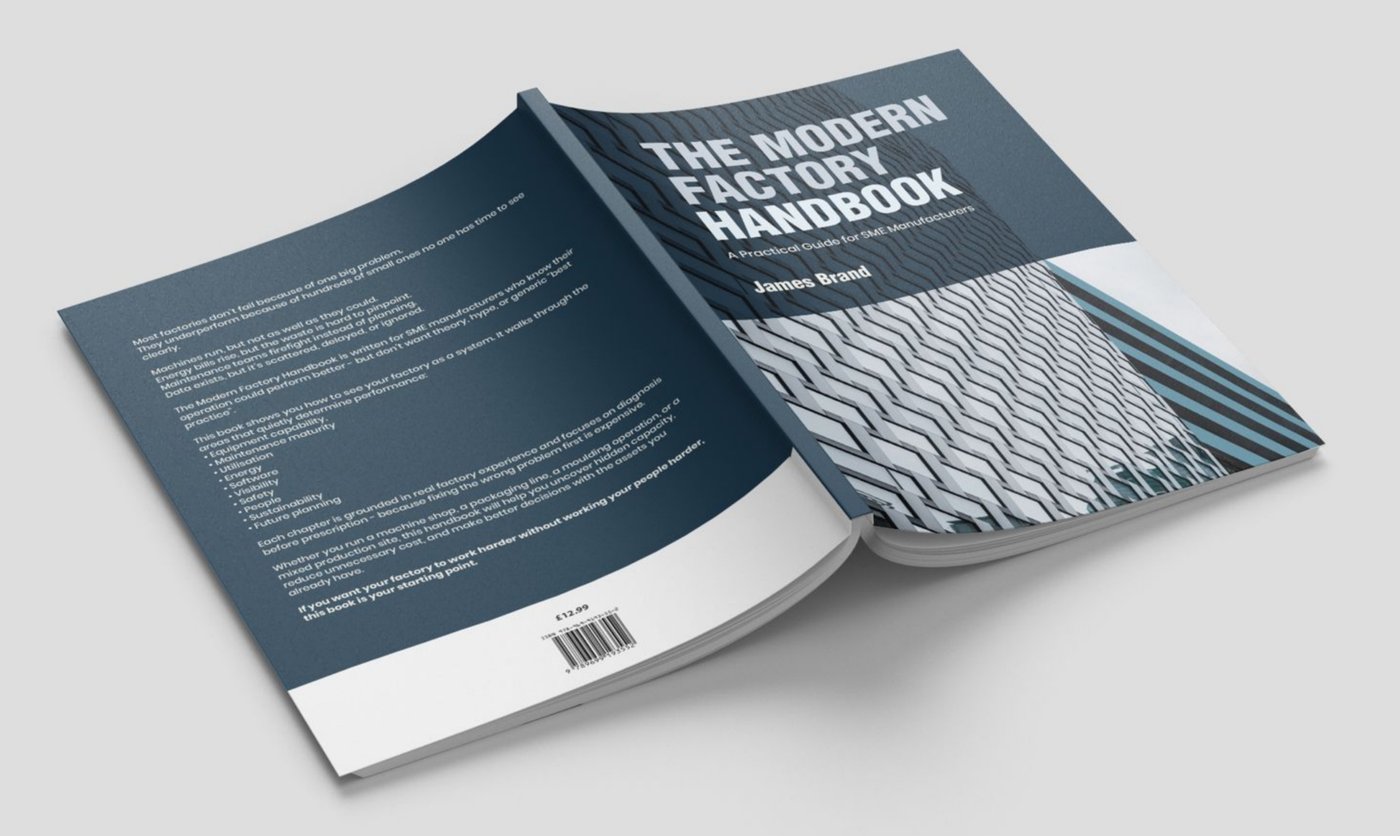
The thinking behind the platform.
Factory Doctor grew out of The Modern Factory Handbook - the diagnose-before-you-prescribe approach that founder James Brand refined across dozens of sites, from food production to precision engineering.
Hands-on with PLC programming, SCADA, IoT integration and energy monitoring - the practical realities of making technology work on a real factory floor.
Read the handbook →You already know some things could be better.
Now find out what to fix first. Sign up and get your tailored report - instantly.
Start free at factory.doctor →